Plumbing
You are here
Plumbing Roof-Mounted Solar Collector Arrays
When you're plumbing flat-plate collectors, you need to attach the incoming colder supply part of the solar loop to one end of the array, at the bottom. The outgoing hot part of the loop must exit at the other end of the array, at the top.
Mounting Heat Exchangers
In many cases, mounting the heat exchanger is one of the easiest parts of system installation, especially if you buy a pre-packaged kit; you just put the module on the storage tank and tighten a few unions. However, you may decide to construct your own heat exchanger from individual parts. In any case, the first step is to install the storage tank, then attach the exchanger.
Preparing for Plumbing
Good plumbing is a return on investment in itself. Proper plumbing, carefully planned and implemented with professional soldering and workmanship can last 100 years, so it's worth doing it right. If you're a newbie, you will want to either practice beforehand or employ a skilled professional.
Solar Thermal Plumbing Toolkit
Before you start any serious plumbing work, make sure you have the right tools. Your system schematic (you did create one, didn't you?) will tell you how much piping you need, as well as all the fittings and other consumables required.
You will also need:
How to Measure, Cut and Clean Copper Pipe Runs
There is a definite art to plumbing with copper pipes. Thankfully it's fairly quick to learn, though your first few cuts and joins are likely to produce amateur results. If you've never installed copper pipes before, buy some extra parts and practice!
How to Solder Copper Pipes
If you're new to plumbing, you will want to practice soldering pipes before you try your skills on an actual solar thermal installation. It's not difficult but it's extremely important to do the job well or you'll get leaks and other problems. Practice makes perfect!
Layout Patterns for Radiant Floor Tubing
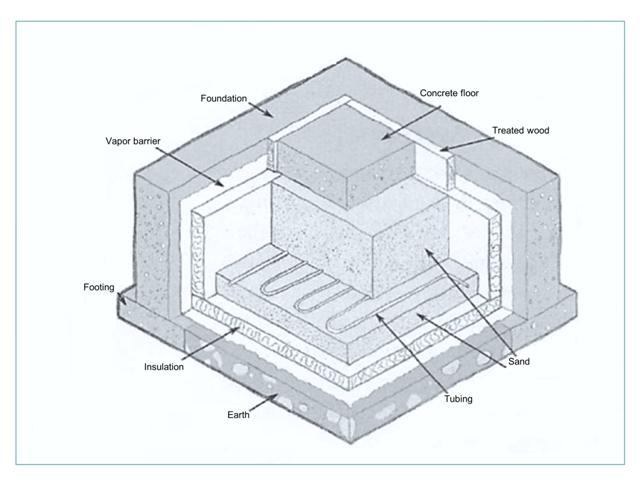
When you opt for radiant floor heating, you opt for the most efficient, cheapest and most comfortable heating available, especially when you combine it with a solar thermal installation. The big question for radiant floor installation is how to lay out the piping that carries the hot solar fluid through the high-mass heating medium.
How to Prepare Pex Tubes for Radiant Heating
Back when modern radiant floor systems were first installed, copper or steel pipes were used. They were embedded in concrete under the floor and hot water ran through them to heat the building. It doesn't take a genius to see where the problems came from:
How to Calculate Pex Length for Radiant Heating
There is an upper limit on how much Pex tubing you can use in a radiant heating installation. If the circuit is too long, the solar fluid will cool off before it reaches the end and you will get uneven heating. For standard-sized Pex tubes (half-inch or 5/8-inch internal diameter), the circuit length should not exceed 300 feet – which is conveniently the size of the coil supplied by many manufacturers.