Solar
You are here
How to Choose Non-Solar Windows
A good passive solar home design maintains a balance between solar and non-solar windows. Solar windows are those which face the sun, on the side of the house pointing true south; non-solar windows are those on the other sides.
What is Natural Conditioning?
If you're thinking of building your own home or work in the construction industry, you need to know about "natural conditioning". Otherwise known under a variety of names, such as "passive solar" and "day-lighting", this is the practice of designing and building a home so that it works to reduce your heating bills by optimizing natural heating and cooling.
What is Holistic Home Design?
Most engineers call it "integrated design", but green systems installers like to use the word "holistic" because it rings of holistic therapy, holistic medicine and other natural alternatives that work just as well as their traditional counterparts. But what is it?
Advantages and Disadvantages of Holistic Home Design
Holistic or integrated home design is the art and science of creating homes which take full advantage of the natural resources available – notably light and heat – while providing a comfortable, pleasant living environment. Like all things, it has its advantages and disadvantages.
Building Layouts for Passive Solar
The ideal layout for a home built around passive solar concepts is a simple rectangle. Not only does this ensure that the long axis of the building gathers as much solar energy as possible (assuming it faces true south, of course), but it also limits the amount of summer heat gathered by the east- and west-facing sides.
Thermal Mass for Passive Solar Homes
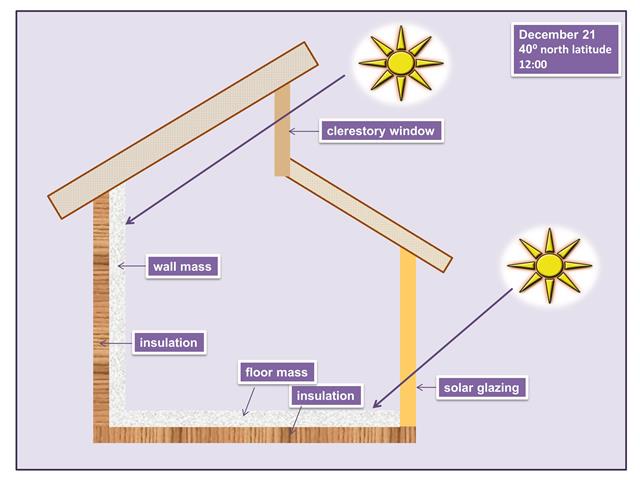
"Thermal mass" is all the stuff inside your home which the sun can heat: it includes everything from the walls and floor to furnishings to special construction materials designed to absorb and retain warmth. When you talk to professional installers, it is unlikely they will include minor incidentals in their definition of the term - they're mostly concerned with dedicated mass such as concrete slabs and Trombe walls.
Using Thermal Mass in Passive Solar
Thermal mass is everything inside a home that absorbs, retains and later emits heat, effectively providing free heating. Like most things in home construction, there are many different approaches to its use.
How Much Thermal Mass Should I Install?
At first glance, you might think that it's impossible to have too much or too little thermal mass. After all, if there's loads of it, your home will store more heat; if there's very little, you'll still get the benefits of what you do have.
But it's not as simple as that.
Room Layout for Passive Solar Homes
In an ideal passive solar world, homes would be built as a long string of single rooms, so that every room would be heated by the sun and there would be no need to transport warmth from warmer to cooler rooms. In practical terms, long houses are rarely appropriate: traffic flow inside such buildings is often difficult and housing lots in towns and cities tend to be square or rectangular, rather than extended oblongs.